About Tassos
Tassos Petrou came to Salesforce through a client requirement that didn’t follow the usual route. In 2018, a client needed a customer portal web application integrated with Salesforce. Tassos built it, and in doing so, discovered a platform he’d spend the next eight years mastering. What started as a single integration project became a career built on understanding how Salesforce connects to the wider systems around it.
His early career at a startup integrator, running multiple client engagements simultaneously, shaped a practitioner who can hold an entire delivery in his head at once: business analyst, architect, developer, and tester, without losing the thread. Working across many clients and projects at the same time meant there was no room to specialise narrowly. You either developed range quickly or you struggled.
That breadth has proved most valuable on programmes where the stakes are high and the tolerance for ambiguity is low. When there is no single owner, no clean documentation, and no room for error, the job requires someone who can move across the full delivery without dropping anything.
In Their Own Words
What do you enjoy most about this work?
The end-to-end involvement, facing the customer, acting as BA, architect, developer, and tester. All in one.
What does a successful project look like?
The team dynamic matters a lot. And the client has to be in it with you. When both sides are genuinely engaged and the requirements are worked through properly at the start, everything else is easier. When they are not, no amount of technical skill fixes it.
Engagement Highlight
Data Migration and Platform Porting: National Telecom Operator
His most significant programme to date is the data migration and platform porting for a national telecom operator’s Billing and Charging System. This is critical infrastructure: data integrity issues carry direct commercial and regulatory consequences, and the margin for error is effectively zero. The programme required the kind of end-to-end ownership that Tassos’s background is built for, holding the full picture across analysis, architecture, and delivery simultaneously.
A similar pattern played out on a legacy CPQ migration for a major energy retailer. The client needed to move to Salesforce without interrupting commercial operations. The technical complexity was compounded by years of undocumented product configuration rules with no single owner. Tassos led the analysis, rebuilt the logic in structured configuration, and delivered the migration on schedule.
Twelve months in, the engagement is ongoing and expanding. Consistent delivery outcomes across multiple workstreams. The initial scope has grown into broader opportunity — not through upselling, but through demonstrated results that earned further trust and investment from the client.
About Grzegorz
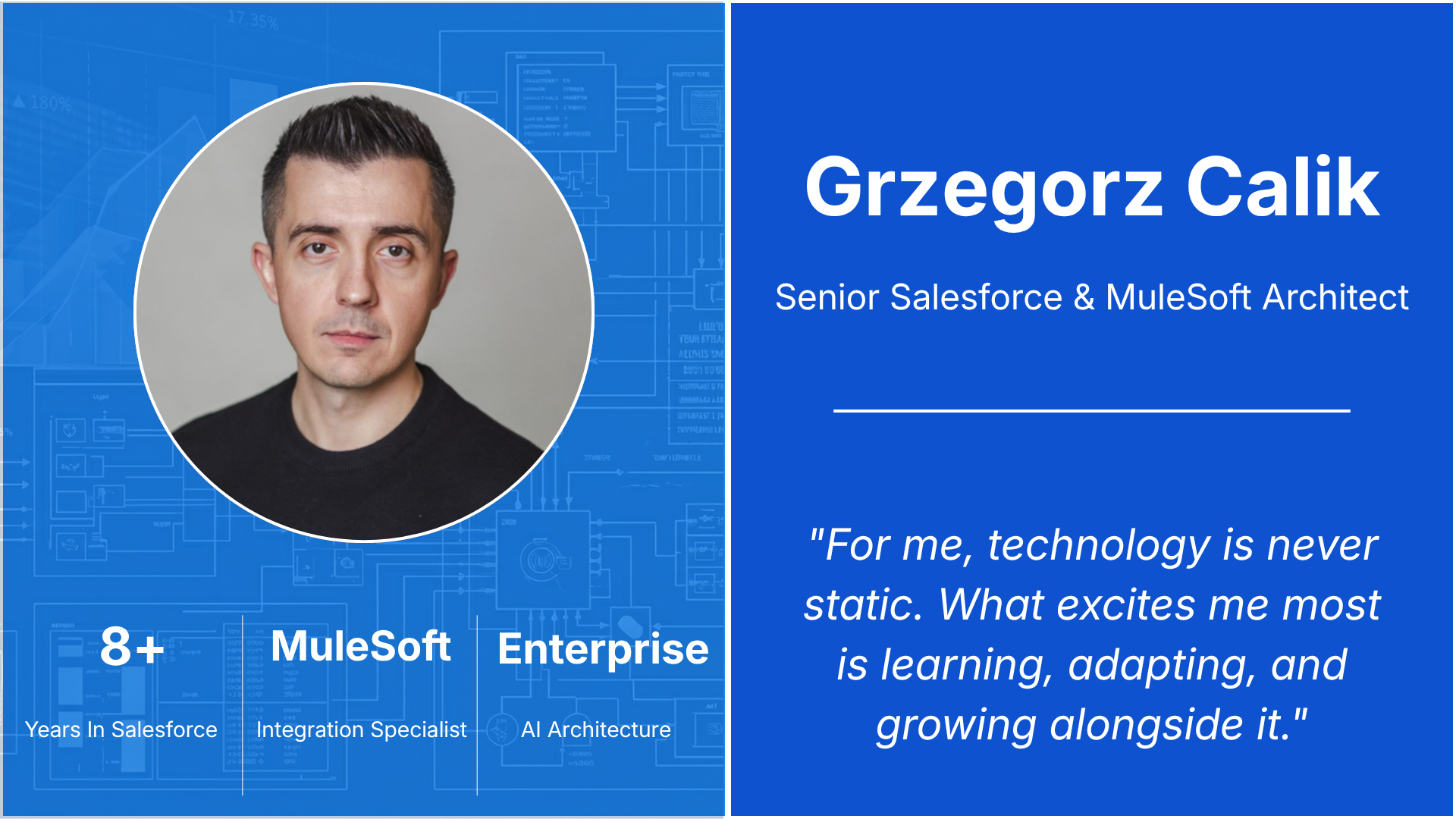
Grzegorz Calik came to Salesforce from the outside in. As an iOS developer in the early smartphone era, his clients kept using Salesforce as a backend integration layer, giving him deep familiarity with the platform from an API and systems perspective before he ever worked inside an org directly. That outside-in foundation means every system he builds is designed to fit into something larger, not just to work on its own.
By 2019, he had transitioned fully into the Salesforce ecosystem, beginning in a DevOps role focused on CI/CD strategy, environment governance, and release management for enterprise programmes. That grounding is why he thinks about deployment, governance and operational stability at the same time as he thinks about the build.
Today, Grzegorz specialises in complex integration landscapes and AI-driven solutions within Salesforce, with increasing focus on production-grade AI architectures: Agentforce, MCP integrations, and security-first system design.
What do you enjoy most about consulting and delivery work?
The opportunity to operate not just as a developer, but as a strong technical partner to the client. I like working directly with customers, understanding their expectations, constraints, and business goals, and then translating those into solid technical solutions. That end-to-end involvement means I’m not just building what’s asked for. I’m accountable for whether it actually works for the client.
How has your perspective on delivery evolved over time?
I’ve shifted from focusing primarily on implementation to prioritising sustainable architecture and delivery quality. I now approach projects by first understanding the broader ecosystem, key stakeholders, and long-term implications of technical decisions.
Engagement Highlight
Cross-Org Compliance Integration — Security Services
A UK security services client operated two separate Salesforce orgs, one for sales and operations, one for HR and compliance, with no reliable way to share employee eligibility and compliance data between them. Eligibility decisions and Right to Work checks were being made on stale or missing data, creating legal and regulatory exposure the business could not afford.
Grzegorz designed a MuleSoft integration architecture using Platform Events for near-real-time sync, a Global Employee ID strategy to prevent duplicates, and a GDPR-aware filtering layer that kept sensitive personal data in the HR org while surfacing only the operational flags that operations teams actually needed. The result was a reliable, automated sync between two previously disconnected systems, with data privacy and compliance built into the architecture from the start.